Saturday, October 7, 2017

Traditional Kira's for Teschu Festival & Panakha Valley


Stephanie and I were told that the Bhutanese people truly appreciate westerners who make the effort to honor their traditions by dressing in their national dress for the Teschu Festival.  So, we began shopping the first day in Paro.  Above I purchased a tradition Kira and stand at the entrance of our first hotel - the Haven Hotel in Paro.

Sonam, the Bhutanese woman who wove this silk and cotton cloth thirty-five years ago, helped me wrap the full-length Kira in the proper way.  I couldn't leave it behind.  Stephanie and I were in that shop for about two hours and Sonam served us tea when we were finished.


 From there we traveled nine hours on Bhutan's National Highway that is under construction from Bumthang to Thimpu.  Below is a typical scene on Bhutan's National Highway. 😱. This is Bhutan's Achilles heel.  Treacherous travel!  There were boulders falling on mountainous sections, as well as cows, horses, and stray dogs happily using the road-- often at hairpin curves. And there's only this one road to and from Bumthang. This highway brought our "happiness index" way down.  Even our driver had white knuckles.


We traveled to the area where the rare Black Necked Cranes migrate, the Gangtey Valley, even though the cranes had not yet arrived.  They come in Mid-October and stay until March to mid-April.  That would be a nice time to return to Bhutan as the famous Rhodedendrons are in bloom throughout the forests of Bhutan.

A rescued Crane with a broken wing that lives there year round.  They are sacred to the Bhutanese and are found in their art going back centuries.

 Fruit and vegetable stand on the side of a mountain en route to Panakha Valley.
Typical scene on the roads of Bhutan.


I really loved the Panakha Valley in Central Bhutan.  This is a cell phone photo from the terrace of the RKPO Green Resort hotel. Four stars and quite nice.


The RKPO Green Resort Hotel in Panakha Valley.

 Housekeepers in their national dress as they work.
The windows of Bhutan are all fashioned like this and are painted.  This one was especially ornate at the Green Hotel.
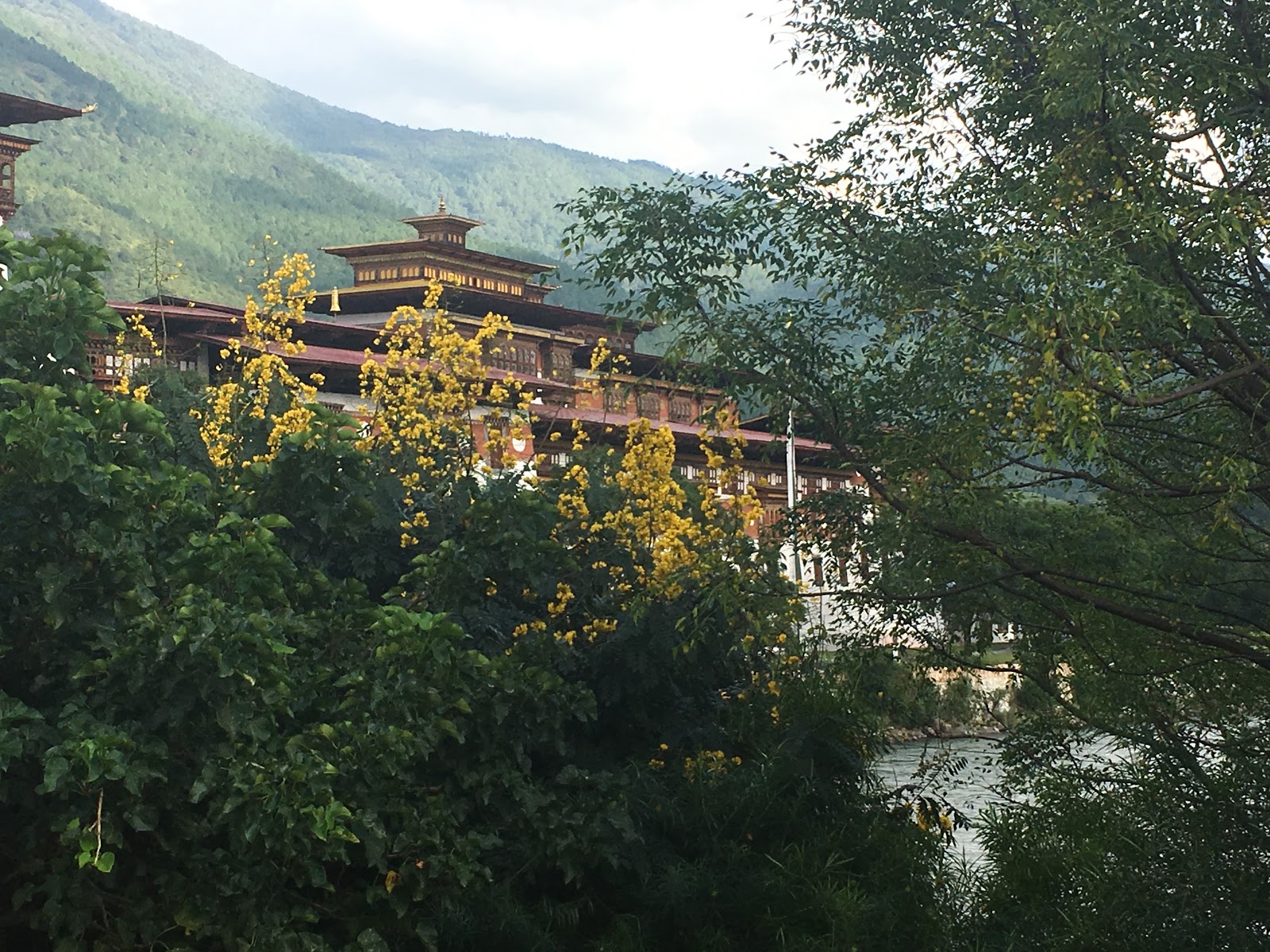
 This Fort, the Gaza Dzong, is considered the most beautiful in Bhutan and I agree!
 Tashi and Stephanie taking it all in.
The Fort sits alongside the Mo Chu River.
                                                      Footbridge over the Mo Chu River.

The King and Queen and Bhutanese Children

As we've traveled wherever we go there are photos of the current, the fifth, King of Bhutan, Jigme Khesar Namgyel Wangchuck, and his beautiful wife, Queen Jetsun Pena Wangchuk.  Sometimes the photo also pictures them with their new son, Prince Jigme Namgyel Wangchuk, who is the crown Prince.

The history of Bhutan goes back to tribal times in the 2nd Century and is full of amazing myths based on Buddhist legends.  It's too complicated for me to recount on this blog, and I've only glazed the surface of its complexity, but it's fascinating to read about and explains why Bhutan is the compassionate, gentle country it is today.

They have only had a system of King and Queens since 1907 and the fourth King had four wives - all sisters from the Bumthang valley.  They had ten children between them and the current King descends from them.  He married Jetsun Pema, ten years his junior, pictured above.  They make a handsome couple and everyone worships them.  They are benevolent, good natured royals, like his father before him. The current King was educated both inside and outside of Bhutan attending a defense school in Delhi, the Wheatley School in Massachusetts, and Oxford in England.  While men in Bhutan can take more than one wife--if they can afford it--this King has announced that he will only have one wife.  Bhutan is moving swiftly into the modernized world and he sets the example. They now have laws forbidding spousal abuse and I was told by our guide that the men get a stiff sentence, as opposed to just twenty years ago when they weren't punished at all.  In general, things have been changing rapidly since the nineties and what was the usual tradition of getting married and moving into one or the other parent's houses has begun to crumble and young married couples can go to their capital city, Thimpu, and get an apartment on their own.  When they have children the grandmothers share the care of the child as the wife and husband go to work.  They need to have an extra bedroom in their apartment for the mother to stay since she sometimes stays for six months while her husband remains at the family residence - usually in a beautiful rural valley somewhere. Bhutan is having the same issue with the rural youth wanting to go to the two main cities, Thimpu and Paro, instead of working the land as their parents did before them.  Everyone gets free education now and the children study English for five years.  Stephanie and I were quite surprised when we could easily converse with school children.  They asked us where we were from and what did we like about Bhutan?  Then they run off to play.  No worries about someone snatching your child here - children walk home together playing as they go.  Just beautiful!

 Traditional Dress Uniform for the school-age children.
The girls like to match the red color with their hair ties.
The girl's hair must be tied back in some way.

Even the litttle children are in traditional Kiras.  

Young woman in the traditional manner of carrying the baby tied to her back so that she can operate her handmade Bhutanese paper shop in Thimpu Handicraft Market.   Women have equal rights in Bhutan and are able to inherit property when their parents die.  Increasingly young women are opening and managing their own shops to augment the family income.

Bhutan is a Constitutional Democratic Monarchy.  They have a parliament and that body oversees most internal affairs while the King has the power to veto Foreign affairs.  They have only had two voting periods to date but it seems to be going fairly well.  The constitution was just created and voted on in 2005 & 2006.The Constitution was officially adopted in 2008.  The Bhutanese voted again in 2013 and the first party lost all its seats and the People's Democratic Party swept to power in the National Assembly.  The Prime Minister met with John Kerry in India in 2015.  According to my Lonely Planet book the most contemporary and complete history of Bhutan in English is The History of Bhutan by Karma Phuntso.


Wednesday, September 27, 2017

Bumthang - City of Temples and Beautiful Himalayas

Bumthang - City of Temples and Beautiful Himalayas

The flight from Paro to Bumthang is an exquisite half hour overlooking the pristine beauty of the Himalayas.  It's important to sit on the left side of the plane where you get a gorgeous a
riel view of Thimpu.  The Bumthang airport is the smallest airstrip you've ever encountered, not to mention the lack of a building usually called a terminal.  All quite charming.  They bring your luggage in a large wagon to the field where the cars are parked and everyone just grabs their bags and take off.
This is the Bumthang Airport Terminal

We had a day-long drive to Ura in the Tang Valley that was a cluster of beautiful houses - a Bhutanese village of 7,000 people.  The drive there was on their old national road but very few people use it anymore.  It was abosolutley breathtaking.  There are no signs along the road, absolutely nothing to mar the natural beauty of the mountainous landscape.  

A recently constructed temple by the men in the local village.

Tashi showed us an incredible crumbling former residence of the King.  They are restoring it in honor of the recent birth of the prince. 

Tashi, our guide, had an old friend, Yeshey, who lived in Ura and so he called him and we got an invitation to have lunch at his house.  We'd brought food that was prepared at the hotel so he supplemented our lunch with his own home made wheat and barley liquor.  Stephanie tried it and Yeshey then added a little bit of egg in her cup as they always do.  Strange to us but Steph said it tasted good.


We took a hike down a steep mountain to the Ura valley.  These two stray dogs accompanied us the whole way down - at a respectable distance.  We also saw many prayer walls and prayer flags.  


Ura Village in the distance

Archery is the national sport and they compete in the Olympics.  We came across boys practicing.


Ura Valley - they grow potatoes


On our return drive back to Bumthang we came across this man on the road and stopped to take a photo.  He was amenable and told a story of other tourists who had asked him before and he had said no, just to tease them, but he really didn't mind.  Tashi said to offer money would offend the Bhutanese after taking a photo.

Our encounter with a man of the Ura Valley


Gardens of Bhutan


Friday, September 22, 2017

We Made it to Bhutan

We Made it to Bhutan

Nestled between northern India and southern China, Bhutan, or Druk, as the locals call it, feels both magical and otherworldly.  Its 750,000 people are mostly dressed in their national
Druk clothing made in their weaving houses.  Bhutan is comprised of mostly Buddhist followers with about a quarter of the population Hindu.  The country has a charismatic (and photogenic) King and Queen and the Prime Minister is at the United Nations right now representing Bhutan.  From what our guide, Taschi, says, the country is developing quickly.
It took thirteen hours to fly from Philadelphia to Doha, Qatar, then seven hours from Doha to Bangkok.  In Bangkok we had to go to an airport hotel as our lay over was overnight for six hours.  We were able to have a good meal, shower, and sleep two hours, then back to the airport to board Druk Airline's flight to Park, Bhutan that left at 4:30 in the morning - yet another six hour flight.  Travel time was 40 hours all together.


Stephanie and Jeanne at the Bangkok Airport Baggage Claim

Thai dinner at the Nohotel in Bangkok


Our first city was Paro where we stayed at the Haven Hotel.  The Paro Valley is just beautiful.  We took a walk to see the National Museum.  First they explain their dances and
their significance.  There are so many different ones that it would take years to understand them all.  Then they display their clay sculptures, their bronze sculptures and finally their natural beauty featuring their rich and abundant wildlife, and forests.  They are working to become the first country in the world to be carbon neutral.

The old watchtower 


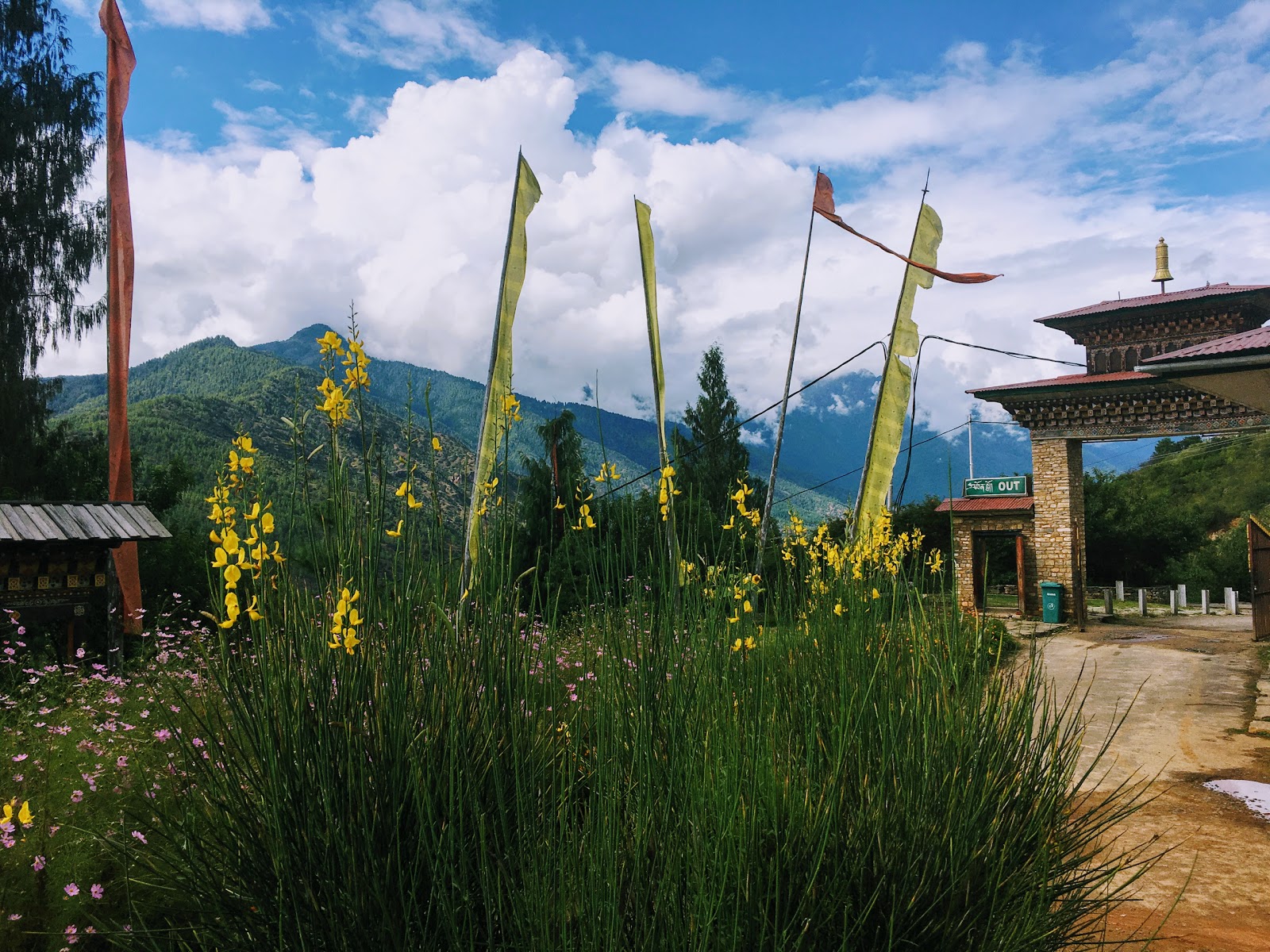
Blue skies and gorgeous mountains with prayer flags


Monday, September 11, 2017

Bhutan Magical Mystery Tour

Leaving for Bhutan tomorrow morning with my great friend Stephanie Eley. We're looking forward to experiencing a place that has been cut off from the world as we know it for so long.  We'll see their spectacular dance festivals complete with intricate dances for each God and colorful costumes, dramatic masks, and hear their music. I'll create a Happiness index as we travel since their country measures their gross national product in Happiness.  Part of the trip will be a three-day camping trek through the beauty of this Himalayan kingdom's mountainous country - between 9,000 and 10,000 feet high.  I've wanted to go there ever since I heard about it in the early 1970's.  So glad Stephanie was eager to travel there with me.  It's a long trip over and I'm not sure how internet will be so I hope. You'll here from me again in a couple days.